How Small Businesses Can Compete Online Without Big Budgets

Small businesses don’t need massive budgets to succeed online. Learn how strategy, consistency, and community can help you compete and grow.

Small businesses don’t need massive budgets to succeed online. Learn how strategy, consistency, and community can help you compete and grow.
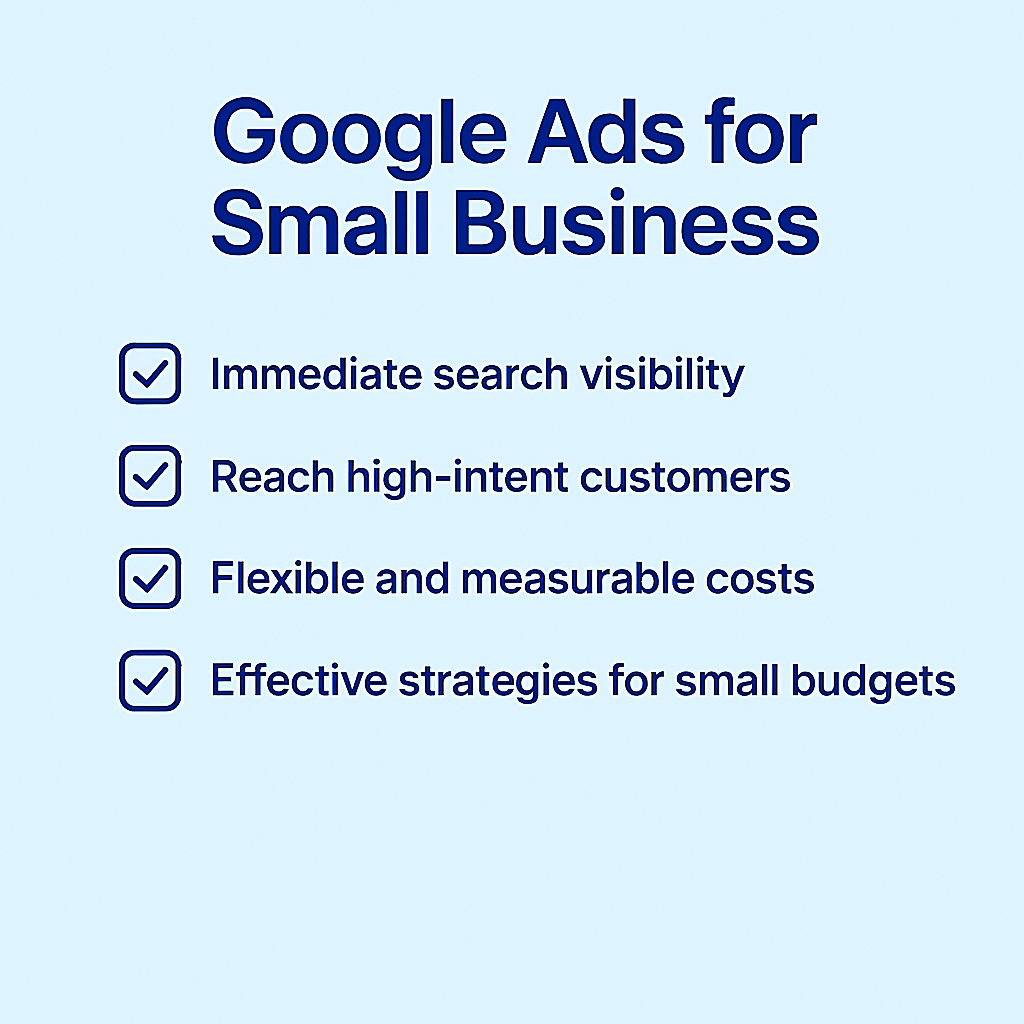
Google Ads remains one of the fastest and most effective ways for small businesses to get new customers—especially when buyers are actively searching for what you offer.
Below is a simple, evidence‑based breakdown of how Google Ads works for small businesses, why it’s so powerful, and how to use it effectively.
Google Ads gives businesses instant placement at the top of search results, unlike SEO which takes months. This visibility captures high-intent searchers exactly when they’re ready to buy. The top three paid ads capture 41% of clicks.
Search ads appear when people are actively searching for your product or service—meaning they are closer to making a purchase. Google Ads lets small businesses reach customers who are literally “raising their hand.”
Small businesses worry they can’t compete with larger advertisers, but research shows Google rewards relevance and ad quality over budget size.
Small and medium businesses earn an average of $8 profit for every $1 spent when campaigns are well‑run.
You set your daily or monthly budget and can pause at any time. There are no minimums. Google Ads uses a pay‑per‑click model, so you only pay when someone actually clicks.
Every click, call, form submission, and purchase can be tracked, making Google Ads one of the most accountable forms of marketing.
Text ads that appear at the top of Google search results.
Best for: Leads, calls, bookings, service businesses.
Pay only for verified leads (calls/messages).
Best for: Plumbers, electricians, HVAC, cleaners, landscapers.
Also appears at the very top above Search ads.
AI-driven campaigns that show ads across Search, YouTube, Maps, Gmail, and Display.
Best for: eCommerce, businesses with strong tracking, or broad targeting.
Note: Not ideal for very small budgets without strong conversion data.
4. Call Campaigns
Designed to generate direct phone calls from mobile searchers.
Best for: Contractors, medical offices, home services.
Google Ads today is highly AI-driven. This affects small businesses in several ways.
Instead of manually picking every audience detail, Google analyzes behavior signals (search history, device, time, intent) to match your ad with likely buyers.
Google is better at interpreting user intent even if search terms vary.
Your job is to start with strong, high-intent keywords and refine using actual search data.
If your conversion data is messy (spam leads, wrong goals, too many conversions tracked), Google’s automation will optimize incorrectly.
Campaigns fail when they try to drive traffic, leads, and sales all at once.
Google learns faster when the goal is crystal-clear.
Show ads only in areas where your customers live.
“Near me” searches have increased by 200%, making local targeting extremely powerful.
Your ad is only half the equation.
A high-converting landing page needs:
This prevents wasted ad spend on irrelevant searches.
Example: A dog groomer could block searches like “DIY grooming tools.”
Negative keywords can reduce wasted spend by 30–50%.
PMax works only when Google has strong conversion data.
Small budgets should usually begin with Search campaigns first.
A local HVAC company launches Google Ads on Tuesday.
By midday, they appear at the top of Search and Maps for “AC repair near me.”
Customers immediately start calling and booking appointments, and the campaign pays for itself within days.
Absolutely—if set up correctly.
Google Ads can transform a small business when campaigns are focused on:
A well-managed campaign can yield up to 8× return on ad spend.