Artificial intelligence has quickly become one of the most talked‑about tools in digital marketing. From writing blog posts to generating keyword ideas, AI promises faster results, lower costs, and instant execution.
So the question many business owners are now asking is simple:
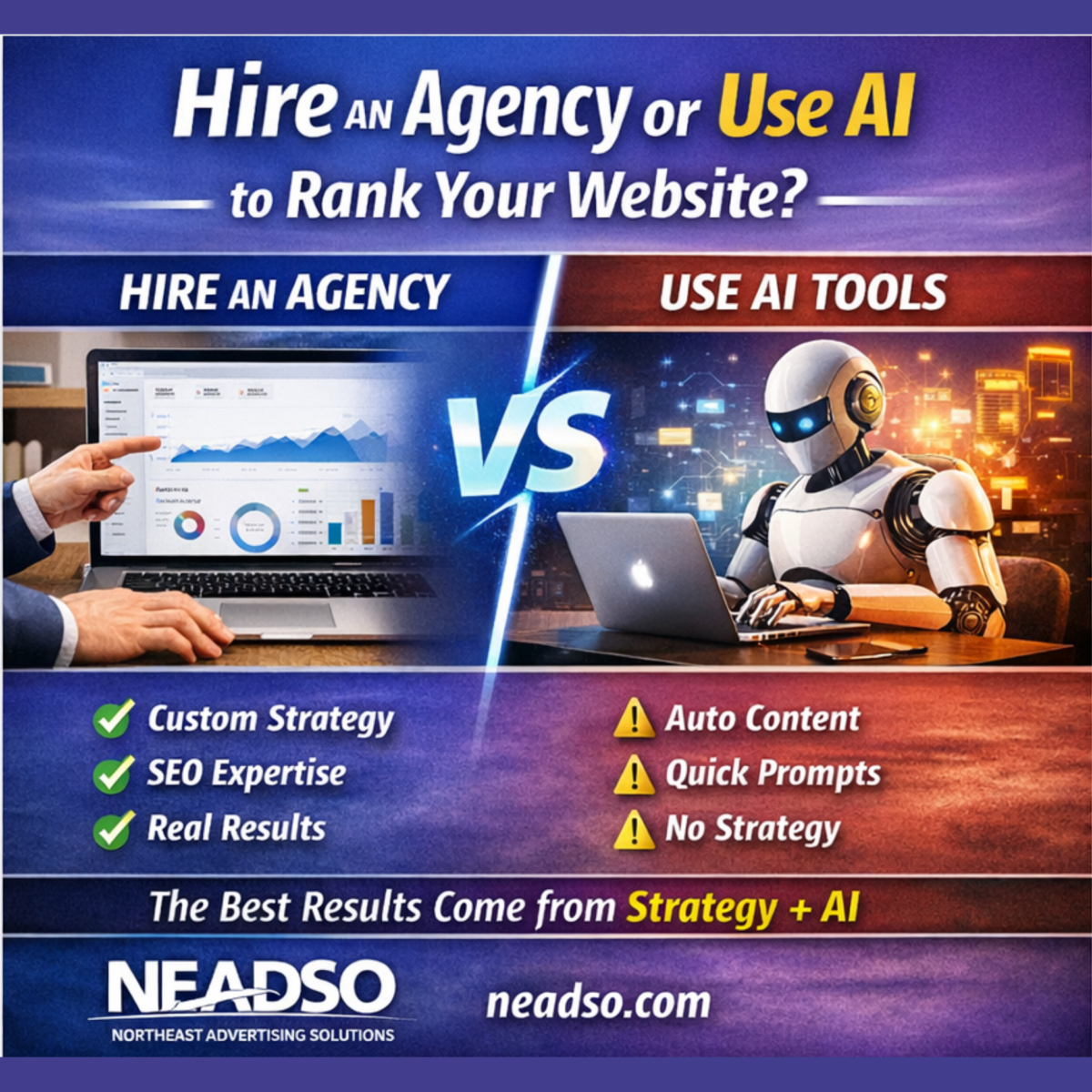
Should you use AI to rank your website — or hire a marketing agency?
The real answer isn’t as black and white as it seems. Let’s break down what AI can do, where it falls short, and why businesses that rely on rankings for revenue still need expert strategy.
What AI Is Actually Good At for SEO
There’s no denying it — AI can be a powerful tool when used correctly.
AI excels at:
Generating content drafts quickly
Brainstorming topic ideas
Suggesting keywords and variations
Writing meta titles and descriptions
Analyzing surface‑level competitor content
Speeding up research and execution
For businesses that already understand SEO fundamentals, AI can dramatically increase efficiency. It saves time, reduces manual work, and helps scale content production.
But speed alone does not equal results.
Where AI Falls Short (And Why Rankings Stall)
Here’s where many businesses run into trouble.
AI does not understand context, risk, or long‑term strategy. It produces information based on patterns, not business goals or search engine nuance.
AI cannot:
- Recognize real‑time Google algorithm changes
- Diagnose technical SEO problems safely
- Decide which keywords actually convert into revenue
- Build authority through relationships and backlinks
- Adapt strategy when results plateau
- Protect your site from over‑optimization or penalties
In fact, many sites using AI alone end up:
- Publishing thin or repetitive content
- Over‑optimizing keywords unintentionally
- Ignoring local SEO opportunities
- Ranking for traffic that doesn’t convert
- Plateauing after initial gains
AI will happily give you an answer — but it won’t tell you if it’s the right answer.
Ranking a Website Is More Than Writing Content
One of the biggest misconceptions about SEO is that it’s just about content.
In reality, ranking involves:
- Technical site health
- Page structure and internal linking
- Search intent alignment
- Local visibility signals
- Conversion optimization
- User behavior metrics
- Authority and trust signals
AI might help write a blog post — but it doesn’t build a cohesive system that turns visibility into revenue.
That’s where strategy matters.
What a Marketing Agency Brings That AI Can’t
A professional agency brings experience, accountability, and judgment — the things AI lacks.
A good agency:
- Builds a custom SEO strategy around your business goals
- Understands how Google behaves in your specific industry
- Balances content, technical SEO, local search, and paid channels
- Uses data to guide decisions — not guesses
- Adjusts strategy as algorithms and trends change
- Measures success by leads, calls, and sales, not just rankings
At NEADSO, we’ve seen firsthand that rankings without conversion are meaningless. Traffic is only valuable if it produces growth.
AI doesn’t understand your margins.
AI doesn’t know your customers.
AI doesn’t care if your phone rings.
An experienced agency does.
The Smartest Approach: Strategy + AI (Not One or the Other)
The most successful businesses don’t choose AI instead of an agency.
They choose:
- Expert strategy powered by AI tools
- Human oversight controlling execution
- AI assisting with speed, research, and scale
- Experience guiding decisions and risk management
Used correctly, AI becomes an accelerator — not a replacement.
Think of AI as the engine.
The agency is the driver, the map, and the mechanic.
Without direction, even the fastest engine goes nowhere.
When AI Alone Might Make Sense
Using AI without an agency may be acceptable if:
- SEO is not mission‑critical to your revenue
- You already understand SEO deeply
- You’re comfortable experimenting and learning slowly
- Short‑term results matter more than long‑term growth
For most businesses, however, SEO mistakes are expensive — not just in rankings, but in lost opportunities.
When Hiring an Agency Is the Better Choice
Hiring an agency is the smarter move when:
- Rankings directly impact revenue
- You want predictable, scalable growth
- You need results without risking penalties
- You want strategy aligned with conversion
- You don’t want to guess your way forward
SEO isn’t about gaming algorithms. It’s about building visibility that turns into customers.
Final Thoughts: AI Is a Tool — Strategy Is the Advantage
AI is transforming digital marketing, and it’s here to stay. But tools alone don’t create success — strategy does.
AI replaces repetitive tasks. AI speeds up execution. AI improves efficiency.
But AI does not replace experience.
The businesses winning in search are the ones combining:
- Human expertise
- Data‑driven strategy
- Smart use of AI tools
- Ongoing optimization and adaptation
At NEADSO, we believe AI should support your marketing — not run it.
Want to learn how an expert‑led strategy, powered by modern tools, can help your business grow?
👉 Learn more at neadso.com