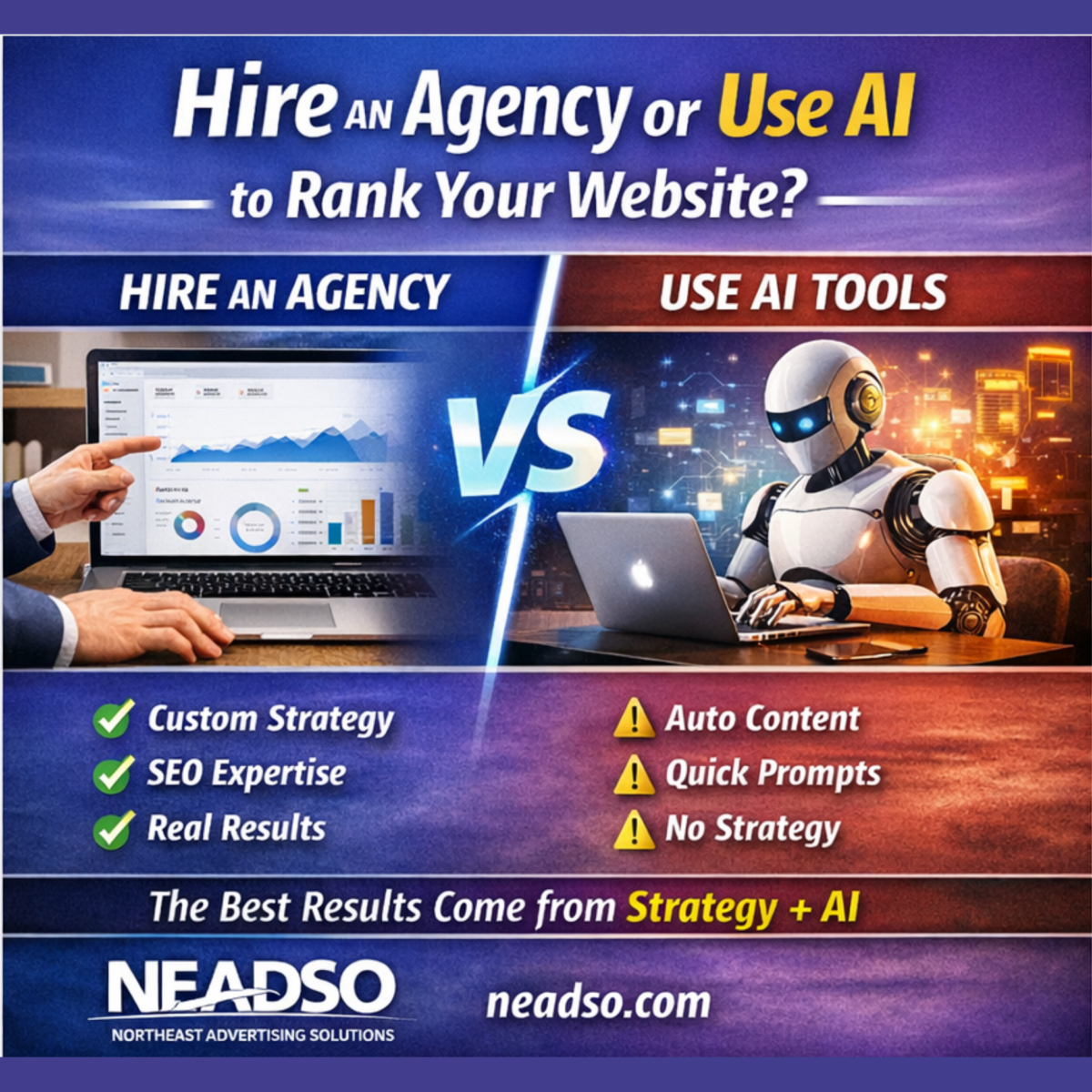
Should You Hire an Agency or Use AI to Rank Your Website?

Artificial intelligence has quickly become one of the most talked‑about tools in digital marketing. From writing blog posts to generating keyword ideas, AI promises faster results, lower costs, and instant execution.

So the question many business owners are now asking is simple:

Should you use AI to rank your website — or hire a marketing agency?

The real answer isn’t as black and white as it seems. Let’s break down what AI can do, where it falls short, and why businesses that rely on rankings for revenue still need expert strategy.

What AI Is Actually Good At for SEO
There’s no denying it — AI can be a powerful tool when used correctly.
AI excels at:

Generating content drafts quickly
Brainstorming topic ideas
Suggesting keywords and variations
Writing meta titles and descriptions
Analyzing surface‑level competitor content
Speeding up research and execution

For businesses that already understand SEO fundamentals, AI can dramatically increase efficiency. It saves time, reduces manual work, and helps scale content production.
But speed alone does not equal results.

Where AI Falls Short (And Why Rankings Stall)

Here’s where many businesses run into trouble.

AI does not understand context, risk, or long‑term strategy. It produces information based on patterns, not business goals or search engine nuance.

AI cannot:

  • Recognize real‑time Google algorithm changes
  • Diagnose technical SEO problems safely
  • Decide which keywords actually convert into revenue
  • Build authority through relationships and backlinks
  • Adapt strategy when results plateau
  • Protect your site from over‑optimization or penalties

In fact, many sites using AI alone end up:

  • Publishing thin or repetitive content
  • Over‑optimizing keywords unintentionally
  • Ignoring local SEO opportunities
  • Ranking for traffic that doesn’t convert
  • Plateauing after initial gains

AI will happily give you an answer — but it won’t tell you if it’s the right answer.

Ranking a Website Is More Than Writing Content

One of the biggest misconceptions about SEO is that it’s just about content.

In reality, ranking involves:

  • Technical site health
  • Page structure and internal linking
  • Search intent alignment
  • Local visibility signals
  • Conversion optimization
  • User behavior metrics
  • Authority and trust signals

AI might help write a blog post — but it doesn’t build a cohesive system that turns visibility into revenue.

That’s where strategy matters.

What a Marketing Agency Brings That AI Can’t

A professional agency brings experience, accountability, and judgment — the things AI lacks.

A good agency:

  • Builds a custom SEO strategy around your business goals
  • Understands how Google behaves in your specific industry
  • Balances content, technical SEO, local search, and paid channels
  • Uses data to guide decisions — not guesses
  • Adjusts strategy as algorithms and trends change
  • Measures success by leads, calls, and sales, not just rankings

At NEADSO, we’ve seen firsthand that rankings without conversion are meaningless. Traffic is only valuable if it produces growth.

AI doesn’t understand your margins.
AI doesn’t know your customers.
AI doesn’t care if your phone rings.

An experienced agency does.

The Smartest Approach: Strategy + AI (Not One or the Other)

The most successful businesses don’t choose AI instead of an agency.

They choose:

  • Expert strategy powered by AI tools
  • Human oversight controlling execution
  • AI assisting with speed, research, and scale
  • Experience guiding decisions and risk management

Used correctly, AI becomes an accelerator — not a replacement.

Think of AI as the engine.
The agency is the driver, the map, and the mechanic.

Without direction, even the fastest engine goes nowhere.

When AI Alone Might Make Sense

Using AI without an agency may be acceptable if:

  • SEO is not mission‑critical to your revenue
  • You already understand SEO deeply
  • You’re comfortable experimenting and learning slowly
  • Short‑term results matter more than long‑term growth

For most businesses, however, SEO mistakes are expensive — not just in rankings, but in lost opportunities.

When Hiring an Agency Is the Better Choice

Hiring an agency is the smarter move when:

  • Rankings directly impact revenue
  • You want predictable, scalable growth
  • You need results without risking penalties
  • You want strategy aligned with conversion
  • You don’t want to guess your way forward

SEO isn’t about gaming algorithms. It’s about building visibility that turns into customers.

Final Thoughts: AI Is a Tool — Strategy Is the Advantage

AI is transforming digital marketing, and it’s here to stay. But tools alone don’t create success — strategy does.

AI replaces repetitive tasks. AI speeds up execution. AI improves efficiency.

But AI does not replace experience.

The businesses winning in search are the ones combining:

  • Human expertise
  • Data‑driven strategy
  • Smart use of AI tools
  • Ongoing optimization and adaptation

At NEADSO, we believe AI should support your marketing — not run it.

Want to learn how an expert‑led strategy, powered by modern tools, can help your business grow?
👉 Learn more at neadso.com
WordPress vs. Squarespace: Which Platform Helps Your Website Rank on Google?

At Northeast Advertising Solutions (NEADSO), one of the most common questions we hear from business owners is:

“Should I use WordPress or Squarespace if I want to rank on Google?”

The short answer: both platforms can rank, but only one gives you the long‑term control and flexibility needed for serious growth.

If SEO, lead generation, and measurable results matter to your business, the platform choice is more than a design decision—it’s a strategic one.

SEO Starts With Strategy—Not the Platform

Before comparing tools, let’s be clear:

👉 No website ranks simply because it’s built on WordPress or Squarespace.
Websites rank because of:

  • Strong SEO strategy
  • High‑quality content
  • Technical optimization
  • Consistent execution over time

That said, some platforms make winning much easier than others.

WordPress: Built for SEO Growth

At NEADSO, WordPress is our preferred platform for businesses focused on visibility, performance, and scalability.

Why WordPress Excels at SEO

WordPress gives you full control over critical ranking factors, including:

  • Custom page titles and meta descriptions
  • SEO‑friendly URL structures
  • Schema markup for enhanced search results
  • Advanced redirects and indexing control
  • Detailed content organization (categories, tags, silos)

With professional SEO plugins like Rank Math or Yoast, WordPress becomes a powerful optimization engine.

✅ Best for: Businesses that want to actively grow organic traffic and compete in search results.

Squarespace: Simple, Clean, but Limited

Squarespace is known for ease of use—and that’s exactly where its advantages stop.

What Squarespace Does Well

  • Clean templates
  • Mobile‑friendly design
  • Built‑in hosting and security
  • Basic SEO settings (titles, descriptions, sitemaps)

Where Squarespace Falls Short

  • Limited technical SEO access
  • Restricted schema and structured data control
  • Minimal flexibility for custom optimizations
  • Difficult to scale content strategies

✅ Best for: Small, brochure‑style websites where SEO is not a major growth driver.

Site Performance & Page Speed

Google prioritizes page speed and Core Web Vitals when ranking websites.

WordPress Performance

With proper setup, WordPress can outperform almost any platform:

  • High‑performance hosting
  • Optimized themes
  • Image compression
  • Caching and performance plugins

⚠ Important: Poor WordPress setups hurt rankings—but this is a strategy and management issue, not a platform flaw.

Squarespace Performance

Squarespace handles hosting and optimization automatically, which means:

  • Consistent baseline performance
  • No server access or advanced tuning
  • Less room for improvement as your site grows

✅ Good for simplicity
❌ Limited for competitive markets

Content Is King—and WordPress Wears the Crown

At NEADSO, we build SEO around content that converts.

WordPress Content Advantages

  • Designed for blogging and publishing
  • Easy internal linking
  • Strong content hierarchy
  • Ideal for service pages, guides, and SEO silos

If content marketing is part of your plan, WordPress gives you room to expand without limitations.

Squarespace Content Limitations

Squarespace handles light blogging well—but once content volume grows, organization and SEO flexibility drop off quickly.

Scalability: Where SEO Wins or Loses

SEO compounds over time. The platform you choose should support growth—not cap it.

WordPress Scales With Your Business

  • Expand services
  • Add landing pages
  • Improve technical SEO
  • Integrate marketing tools and analytics
  • Adapt to algorithm changes

Squarespace Often Requires a Rebuild

Many businesses eventually outgrow Squarespace and migrate—often losing momentum, rankings, or content equity in the process.

NEADSO’s Recommendation

✅ Choose WordPress if:

  • Ranking on Google matters
  • You want measurable ROI from SEO
  • Content is part of your growth strategy
  • You want full control and long‑term flexibility

✅ Choose Squarespace if:

  • You need a fast, simple website
  • Your site will remain small
  • SEO is not a primary business driver

The Bottom Line

Your website platform won’t rank your business—strategy will.

At Northeast Advertising Solutions, we don’t just build websites.
We build SEO strategies that generate visibility, traffic, and leads.

WordPress gives businesses the control needed to win long‑term. Squarespace can work—but when growth matters, flexibility always beats convenience.

Ready to Improve Your Rankings?

If you’re unsure whether your current website is helping or hurting your visibility, NEADSO can help.

📈 SEO Strategy
đŸ–„ Website Optimization
🎯 Lead‑Focused Design

👉 FREE SEO TOOL

Contact NEADSO for the solutions your business needs.

How Businesses Can Leverage Web Scraping to Supercharge Their Marketing

In today’s data‑driven world, marketing success depends on how quickly a business can gather, analyze, and act on high‑value information. While traditional research methods are slow and expensive, web scraping gives companies a fast, scalable way to collect real‑time data from across the internet—and transform it into smarter marketing decisions.

From competitive research to lead generation, pricing insights to customer sentiment analysis, web scraping is becoming one of the most powerful tools in modern digital marketing.

Below are the top ways businesses can leverage web scraping to gain a competitive edge.


1. Competitor Monitoring & Market Intelligence

Every business wants to know what competitors are doing—what they’re charging, how they promote products, what customers are saying, and how often they update their offerings.

Web scraping makes competitive intelligence instant and automated:

  • Track competitor pricing changes
  • Monitor new product launches
  • Extract competitor reviews to identify strengths and weaknesses
  • Scrape social content and posting frequency
  • Monitor promotions, service updates, and ad messages

This information helps marketers adjust strategies, refine messaging, and stay ahead of market shifts.


2. Lead Generation at Scale

One of the most valuable uses of web scraping is automated lead harvesting. Instead of manually searching through directories or websites, scraping gathers:

  • Business names
  • Contact information
  • Emails (where publicly listed)
  • Social profiles
  • Locations
  • Services offered

These leads can then be fed into CRM systems or outreach tools, giving sales and marketing teams a steady stream of warm prospects.


3. Reputation & Sentiment Analysis

A brand’s reputation lives online—and so do customer opinions. Web scraping helps businesses collect:

  • Reviews from platforms like Google, Yelp, TripAdvisor, and industry‑specific review sites
  • Social media mentions
  • Forum discussions
  • Blog and news mentions

By analyzing patterns in scraped data, marketers can understand how customers feel about their brand and competitors, helping guide messaging, product improvements, and customer service initiatives.


4. SEO & Content Strategy Insights

Search engines reward content that is relevant, targeted, and better than the competition.

Web scraping can fuel content strategy by gathering:

  • Trending topics
  • Common questions people ask (forums, Q&A sites, Reddit)
  • Keywords and phrases competitors use
  • Meta titles and descriptions from ranking pages
  • Backlink sources
  • SERP data and position changes

This allows marketers to create stronger, more competitive content that meets search intent and ranks faster.


5. Ad Strategy Optimization

Scraping competitor ads, product descriptions, or landing pages can reveal powerful insights:

  • Messaging and value propositions
  • Ad structure and calls‑to‑action
  • Seasonal promotions
  • Visual layouts and design cues

This helps marketers refine their own campaigns and develop ads that outperform the competition.


6. Pricing, Inventory & E‑Commerce Insights

For e‑commerce and retail, staying competitive means reacting fast to changes in the market.

Web scraping lets businesses:

  • Track competitor product prices
  • Monitor stock levels
  • Analyze product descriptions and image use
  • Detect trending items
  • Identify gaps in the market

This data helps optimize pricing, product listings, promotions, and overall marketplace strategy.


7. Real Estate & Local Market Analysis

For real estate agencies, investors, and service providers, scraped data can include:

  • Listings
  • Prices
  • Property attributes
  • Agent information
  • Neighborhood data

Marketers can then target areas with more demand, build localized campaigns, and offer tailored services with highly relevant messaging.


8. Customized Dashboards & Automated Reporting

With the right setup, web scraping can feed directly into:

  • Reports
  • Google Sheets
  • Analytics dashboards
  • CRM systems
  • Custom databases

This automation removes the manual work from research, allowing teams to focus on strategy instead of data entry.


Why Web Scraping Gives Marketers an Advantage

Businesses that leverage web scraping gain:

✔ Real‑time data

✔ Faster decision‑making

✔ Accurate market insights

✔ Better targeted campaigns

✔ Reduced research costs

✔ A competitive edge

Marketing without data is guesswork.
Marketing with web scraping is precision.


Final Thoughts

Web scraping turns the public internet into a rich source of marketing intelligence. Whether you’re looking to generate leads, monitor competitors, improve SEO, optimize ads, or understand customers better, scraping gives you the data advantage needed to grow faster and smarter.