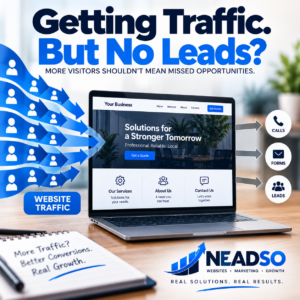
Your website is getting visitors. Google Analytics shows traffic. Your Google Ads are generating clicks. Maybe your business is even showing up well in search.
But the phone isn’t ringing.
Forms aren’t being submitted.
And those website visitors aren’t turning into customers.
If you’re getting website traffic but no leads, getting more traffic isn’t necessarily the answer. The problem may be what happens after someone reaches your website.
Traffic Is Only the First Step
SEO, Google Ads, social media, AI search and other digital marketing strategies are designed to get potential customers to your website.
But getting someone there doesn’t automatically turn them into a lead.
Your website still has a job to do.
It needs to quickly answer questions like:
- What does this company do?
- Do they serve my area?
- Can they solve my problem?
- Why should I trust them?
- What should I do next?
If visitors have to work to find those answers, many will simply leave.
1. Your Website Doesn’t Immediately Explain What You Do
A visitor shouldn’t have to scroll through several sections of your homepage to understand your business.
Your primary message should be clear almost immediately.
Instead of a generic headline such as:
Solutions Designed for You
Consider something specific:
Digital Marketing, Websites & SEO for Small Businesses
Specific messaging helps visitors confirm they’ve reached the right place.
2. Your Calls to Action Are Too Weak
One of the most common website problems is having no clear next step.
Buttons such as Learn More and Click Here don’t tell visitors what they’re actually going to accomplish.
Depending on the business, stronger calls to action could include:
Request a Quote
Schedule a Consultation
Call Now
Get Started
Request More Information
Your website should guide visitors toward taking action rather than expecting them to figure out what to do next.
3. You’re Sending Paid Traffic to Your Homepage
Your homepage has to serve many purposes.
A Google Ads campaign usually has one.
If someone searches for a specific service and clicks an advertisement, the page they land on should closely match what they searched for.
For example, an advertisement promoting commercial financing shouldn’t necessarily send someone to a homepage containing every service the company provides.
A dedicated landing page can focus on:
- The specific service
- Benefits
- Common questions
- Trust signals
- A strong call to action
- A simple lead form
- Phone and contact options
The goal is to reduce distractions and make the next step obvious.
4. Your Website Has Too Many Distractions
More isn’t always better.
Multiple popups, competing buttons, oversized menus, unnecessary animations and too many offers can make it harder for visitors to decide what to do.
Every important page should have a primary goal.
If the goal is generating leads, the design and content should support that goal.
5. Your Forms Ask for Too Much Information
Nobody wants to complete a job application just to ask a business a question.
For an initial inquiry, you may only need:
Name
Email or Phone
What Can We Help You With?
Additional information can be collected after the conversation begins.
Reducing unnecessary form fields can make contacting your business feel easier.
6. Your Mobile Experience Is Hurting Conversions
Your website may look great on your office computer and still be difficult to use on a phone.
Check your website from an actual mobile device.
Can you easily:
- Read the text?
- Navigate the menu?
- Tap the buttons?
- Call the business?
- Complete the contact form?
- Understand the company’s services?
Mobile visitors shouldn’t have to pinch, zoom or hunt for contact information.
7. Your Website Doesn’t Establish Enough Trust
Before someone contacts a business they’ve never worked with, they’re often looking for reasons to trust it.
Depending on your industry, your website might benefit from:
- Customer reviews
- Testimonials
- Professional credentials
- Certifications
- Years in business
- Real team or project photos
- Service-area information
- Case studies
- Clear contact information
People want to know there’s a legitimate business behind the website.
8. Your Website May Be Too Slow
A beautiful website doesn’t help much if visitors become frustrated waiting for it to load.
Large images, unnecessary plugins, poor hosting and bloated website code can all contribute to performance problems.
Website speed isn’t just a technical issue.
It’s part of the customer experience.
9. You’re Not Tracking What Happens After the Click
One of the biggest digital marketing mistakes is measuring clicks instead of results.
Businesses should know whether visitors are:
- Calling
- Submitting forms
- Requesting quotes
- Scheduling appointments
- Making purchases
- Completing other important actions
This becomes especially important with paid advertising.
If you’re spending money on Google or Meta Ads but aren’t properly tracking conversions, it becomes much harder to determine which campaigns, advertisements and keywords are actually producing business.
10. Search Is Changing — and So Are Your Visitors
Potential customers aren’t discovering businesses only through traditional Google searches anymore.
They’re also using AI-powered search results and tools to research businesses, compare services and answer questions before visiting a website.
That means some visitors may arrive at your website already knowing quite a bit about what they’re looking for.
Your website needs to continue that journey.
Clear service information, useful content, FAQs, strong business information and easy conversion options can help turn those highly informed visitors into actual leads.
Don’t Buy More Traffic Until You Fix the Destination
When a website isn’t generating leads, the immediate reaction is often:
We need more traffic.
Sometimes you do.
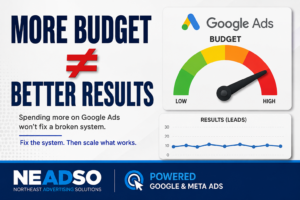
But spending more on Google Ads, SEO or social media won’t necessarily solve a conversion problem.
Imagine sending 1,000 people into a store where nobody greets them, the products aren’t clearly labeled and nobody can find the checkout counter.
Sending another 1,000 people through the door doesn’t fix the problem.
Your website works the same way.
Before spending more money attracting visitors, make sure the website is ready to convert them.
Turn More of Your Existing Traffic Into Opportunities
NEADSO helps businesses connect the different pieces of their digital marketing—from websites and hosting to SEO, Google and Meta advertising, lead forms, tracking and AI visibility.
The goal isn’t simply to generate more clicks.
It’s to build a digital system that helps turn those clicks into real business opportunities.
If your website is getting traffic but not generating the calls, inquiries or leads you expected, it may be time to find out what’s happening after the click.
Visit NEADSO.com to learn more.