For years, the goal of SEO sounded pretty simple:
Get your website to the top of Google.
And while strong Google rankings are still incredibly valuable, the way people search for businesses has changed.
Today, a potential customer might find your business through Google Maps. They might read your reviews before ever visiting your website. They might ask a detailed question in an AI-powered search experience. They could use voice search on their phone, search for a service “near me,” or discover one of your articles while researching a problem.
That means modern SEO isn’t about winning one position on one search results page.
It’s about making your business easier to find, understand and trust across the entire search ecosystem.
The #1 Ranking Isn’t the Only Place Customers Look
Think about the last time you searched for a local business.
Did you automatically click the first traditional website result?
Probably not.
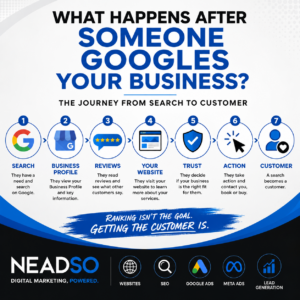
You may have looked at the businesses appearing on Google Maps, checked star ratings, read a few reviews, looked at photos, compared websites and then decided which company deserved your call.
Google confirms that local results appear across both Google Search and Maps, with local visibility influenced primarily by relevance, distance and prominence.
For a small business, that’s an important distinction.
You don’t simply want your website to rank.
You want your business to appear when and where a potential customer is looking for what you offer.
SEO Now Has Multiple Doors Into Your Business
A good SEO strategy creates multiple opportunities for someone to discover you.
1. Traditional Google Search
Organic search results are still a major part of SEO.
Your website needs pages that clearly explain your services, answer the questions your customers are asking and help search engines understand exactly what your business does.
But simply stuffing keywords onto a page isn’t the answer.
Successful SEO combines relevant content with good website structure, internal linking, technical performance and an overall experience that is useful to the person performing the search.
2. Google Maps & Local Search
For local businesses, Maps can be every bit as important as traditional website rankings.
Someone searching for:
“divorce attorney near me”
“urgent care near me”
“window blinds Rhode Island”
or
“bathtub reglazing near me”
may see local business results before they ever reach traditional organic listings.
That’s why your Google Business Profile, business information, website, reviews and local relevance should work together.
Google recommends maintaining complete and accurate Business Profile information and says reviews and positive ratings can contribute to a business’s local prominence.
Your website SEO and Google presence shouldn’t operate as two completely separate strategies.
They should support each other.
3. Reviews Are Part of Your Search Presence
Getting found is only half the battle.
Once someone finds you, you need to give them a reason to choose you.
That’s where reviews become incredibly powerful.
Imagine two businesses appearing next to each other in local search.
One has a handful of reviews and hasn’t responded to any of them.
The other has a steady stream of recent reviews, strong ratings and thoughtful responses from the business.
Which one would you investigate first?
Reviews provide the social proof that can turn search visibility into actual calls, leads and customers.
Modern SEO therefore isn’t simply about “Can Google find you?”
It’s also about:
“What does a potential customer see when they find you?”
4. Helpful Content Creates More Ways to Be Found
Your service pages shouldn’t be the only pages attracting potential customers.
Articles, FAQs, guides and other useful content can answer the questions people ask before they’re ready to contact a business.
For example, a potential customer may not initially search:
“Hire an SEO company.”
They might search:
“Why isn’t my business showing up on Google?”
That question creates an opportunity.
A useful article can introduce that person to your company while they’re researching the problem — potentially long before they start comparing providers.
Google’s guidance specifically recommends creating helpful, reliable, people-first content rather than creating pages primarily to manipulate search rankings.
That’s an important philosophy for small businesses:
Don’t create content just because you want traffic. Create content because your customers actually need the answer.
Traffic can become the result.
5. AI Is Changing Search — But Good SEO Still Matters
AI-powered search has created a new question for businesses:
“How do I get my business to show up in AI search?”
There isn’t a magic switch.
Google says that its existing SEO fundamentals remain relevant to its generative AI experiences. Pages still need to be crawlable, indexable, understandable and useful.
Google’s guidance for generative AI search also emphasizes unique, valuable content based on real expertise rather than generic content that simply repeats what’s already available online.
That makes your actual business knowledge increasingly valuable.
What questions do customers constantly ask you?
What mistakes do you see customers make?
What advice do you give someone before they buy?
What have you learned after years of doing what you do?
Those answers can become valuable website content.
Instead of asking:
“How can we create more SEO content?”
Businesses should increasingly ask:
“What do we know that would genuinely help our customers?”
That’s a much stronger starting point.
Your Website Is Still the Center of the Strategy
With Google Business Profiles, social media, reviews and AI search getting so much attention, it’s easy to underestimate the importance of your website.
Don’t.
Your website is the digital property you control.
It’s where you can fully explain your services, establish expertise, publish useful content, showcase your work and convert visitors into leads.
It’s also an important source of information search engines can use to better understand your business.
That’s why technical SEO still matters.
Your site should be:
- Fast
- Mobile-friendly
- Easy to navigate
- Properly structured
- Crawlable by search engines
- Built around clear services and topics
- Connected with meaningful internal links
- Filled with useful, original content
The goal isn’t simply to impress Google.
The goal is to create a better website for the people Google sends to you.
Stop Thinking About SEO as a Ranking
This may be the biggest shift businesses need to make.
Instead of asking:
“Where do I rank?”
Start asking:
“How many ways can a customer find me?”
Can they find you in traditional Google results?
Can they find you on Maps?
Does your Google Business Profile accurately represent your business?
Do you have strong reviews?
Does your website answer important customer questions?
Do you have useful content around your services?
Can search engines clearly understand what you do and where you do it?
Are you building the kind of original expertise that can also be useful in AI-powered search?
That’s a much more complete picture of SEO.
That’s the Idea Behind NEADSO Powered SEO
At NEADSO, we don’t believe SEO should revolve around chasing a single ranking.
Powered SEO is about building a stronger overall search presence.
Your website, content, local presence, Google visibility and ongoing optimization should all be working toward the same goal:
Get Found. Get Seen. Get More Customers.
Because ranking #1 is great.
But being visible everywhere your customers are searching?
That’s even better.
[Learn more about NEADSO Powered SEO → neadso.com/powered-seo/]