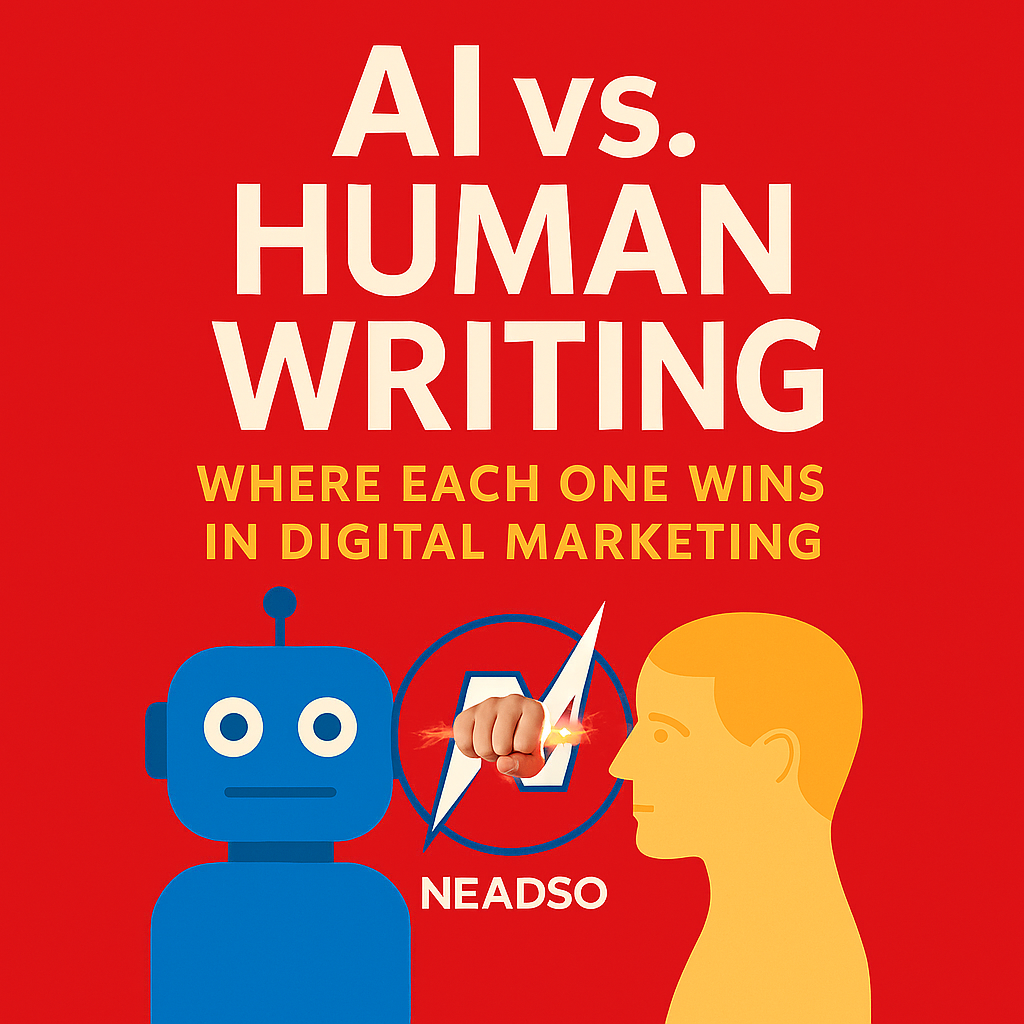
AI vs. Human Writing: Where Each One Wins in Digital Marketing

Artificial intelligence has transformed digital marketing—especially content creation. Businesses now have access to tools that produce blogs, ads, emails, and social posts in seconds. But despite AI’s speed and scale, human writers still provide something AI cannot replicate: lived experience, emotional nuance, and brand‑defining creativity.
Instead of choosing one over the other, the smartest marketers are blending both. Here’s a clear breakdown of where AI wins, where humans win, and how NEADSO‑guided strategies can help you integrate both efficiently.
Where AI Writing Wins
1. Speed, Scale & Efficiency
AI can generate large volumes of content—blogs, product descriptions, email drafts, social captions—in seconds. For digital marketers who manage multiple brands or urgent deadlines, this speed is unmatched.
Best Use Cases:
- First‑draft generation
- Brainstorming topic ideas
- Bulk content (FAQs, metadata, listicles)
- Rewriting in different tones
- Rapid A/B testing of ads and headlines
AI shines when you need more output, faster, without compromising consistency.
2. Data‑Driven Optimization
AI tools analyze search trends, SERP intent, and competitive content to make SEO‑driven recommendations. That means smarter keyword usage, improved structure, and better ranking potential.
Why it matters for NEADSO.com
Digital marketers supporting multi‑location organizations can use AI to uncover:
- High‑intent keywords
- Localized content clusters
- Patient‑critical informational topics
- Optimized structures designed to rank
AI becomes a strategic assistant—not just a writing tool.
3. Consistent Brand Standards Across Large Systems
For brands with many locations or teams, maintaining consistent messaging can be challenging. AI can enforce tone, terminology, and brand rules automatically.
This is especially useful in large organizations where multiple people contribute content.
Where Human Writing Wins
1. Emotion, Storytelling & Connection
AI can mimic tone, but it cannot feel anything. It lacks personal history, sensory experience, and emotional intuition.
Humans excel at:
- Brand storytelling
- Empathy‑driven messaging
- Humor, suspense, personality
- Campaign concepts that feel real and original
Authenticity is a human strength—and audiences can tell the difference.
2. Strategic Thinking & Creative Judgment
AI provides options, but it cannot decide which direction aligns best with business goals. Human writers understand context, nuance, and the “why” behind the work.
Humans outperform AI in:
- Campaign planning
- Creative direction
- Messaging strategy
- Reputation & crisis communication
- Complex thought leadership pieces
AI produces text; humans produce meaning.
3. Brand Voice Development
A brand voice isn’t just tone—it’s culture, purpose, and character. Humans shape these elements through lived experience and deep understanding.
AI can apply a voice once it exists, but humans create it.
AI + Human Writing: The Winning Hybrid Strategy
The most successful marketing teams are not replacing writers—they’re augmenting them.
The process looks like this:
- AI generates ideas, outlines, metadata, and first drafts
- Humans refine the narrative, add depth, adjust tone, and inject creativity
- AI optimizes for SEO, readability, and variations
- Humans finalize, ensuring accuracy and emotional resonance
This hybrid method increases speed without sacrificing quality.
What This Means for NEADSO.com and Its Audience
Digital organizations thrive when they adopt efficient, intelligent systems. Incorporating AI into your marketing strategy can:
- Reduce labor time
- Increase consistency
- Improve SEO results
- Support multi‑location scaling
- Strengthen your content pipeline
But human creativity remains the foundation of powerful messaging.
For NEADSO readers, the biggest takeaway is simple:
AI makes you faster; human writing makes you unforgettable.
Conclusion
AI and human writing aren’t competitors—they’re collaborators. AI handles the heavy lifting, while humans elevate content with emotion, strategy, and originality. The key to winning in modern digital marketing is using each for what they do best.
If your organization wants help building a hybrid AI‑plus‑human content system, NEADSO.com offers resources, frameworks, and support to guide your transformation.