Why Service‑Based Businesses Should Outsource Their Digital Marketing

Digital marketing has become a necessity for every service‑based business—whether you run a home service company, professional service practice, creative studio, wellness clinic, or consulting firm. But the digital landscape now moves faster than most small teams can keep up with. Platforms change weekly, algorithms shift, and customer expectations rise year after year.

That’s why more businesses are turning to outsourced digital marketing as a smarter, more cost‑effective, and more scalable solution. In fact, over 25% of business leaders plan to outsource digital marketing, according to Clutch’s 2026 survey.

Below is a breakdown of why service‑based businesses specifically benefit from outsourcing.

⭐ 1. You Access Specialists You Can’t Afford to Hire In‑House

Digital marketing isn’t one job anymore—it’s a collection of specialties:

  • SEO
  • Paid ads
  • Content strategy
  • Email marketing
  • Analytics
  • Social media
  • Conversion optimization

According to 2026 insights, modern growth requires multiple specialists, and a single in‑house generalist can’t cover the depth needed.

Outsourcing gives service providers immediate access to a full team of experts without the hiring, onboarding, salaries, and overhead. neadso.com

⭐ 2. You Reduce Costs and Maintain Flexibility

Hiring even one full-time marketer comes with:

  • Salary
  • Benefits
  • Software subscriptions
  • Management time
  • Training
  • Risk of turnover

Outsourcing replaces that with predictable monthly costs.
TechAger reports that outsourcing gives businesses clearer spending, lower fixed overhead, and easier forecasting, making it ideal for small and midsize service providers.

Clutch also found that companies outsource to cut costs while gaining better performance, especially in SEO, content creation, and paid ads.

⭐ 3. Marketing Has Become Too Complex to Handle Alone

Clutch reports that the marketing landscape now includes multi‑channel campaigns, influencer integrations, short‑form video, AI‑powered tools, and more—making it difficult for service providers to stay current. neadso.com

Content calendars, ad optimization, SEO, analytics, and email automations now require constant monitoring and technical skill.

⭐ 4. You Get Faster Implementation and Better Execution

Growing service businesses often experience long delays because internal teams are too small or too stretched.

Outsourcing solves this by giving you:

  • Faster campaign launches
  • Faster content production
  • Faster optimization cycles
  • Faster troubleshooting
  • Faster scaling during busy seasons

BruntWork reported that outsourced teams can scale campaigns in 2–3 weeks, versus the 3–6 months needed to hire staff internally.

⭐ 5. Your Business Stays Focused on Revenue‑Generating Work

Every hour a service provider spends on marketing is an hour they aren’t:

  • Serving clients
  • Managing operations
  • Improving services
  • Handling sales calls
  • Running the team

Outsourcing “reclaims focus” by removing marketing tasks from the owner’s schedule, allowing leaders to review results—not manage day‑to‑day execution. neadso.com

⭐ 6. Outsourcing Protects Your Business From Risk

Marketing changes fast—and so does talent.

Outsourcing mitigates risk by providing:

  • Continuity (agencies don’t “quit”)
  • Redundancy (multiple specialists back each other up)
  • Data‑driven insights
  • Proven processes
  • Up‑to‑date platform knowledge

As TechAger explains, outsourcing reduces structural risk and dependency on a single employee, which is crucial for service-based businesses relying on consistent lead flow.

⭐ 7. You Gain Access to Advanced Tools You’d Never Buy Yourself

Agencies bring professional-grade tools for:

  • SEO audits
  • Keyword analysis
  • Automation
  • CRM integrations
  • Analytics dashboards
  • Ad tracking
  • Heatmaps
  • A/B testing

BruntWork notes that outsourced teams provide enterprise systems that would be too expensive or complex to maintain internally.

⭐ 8. You Scale Faster and More Predictably

Service-based businesses often deal with fluctuating demand—busy seasons and slow seasons.

Outsourcing makes it easy to scale:

  • Up (during peak seasons)
  • Down (during slow periods)
  • Laterally (adding new services)
  • Vertically (expanding territories)

This “instant scalability,” is one of the biggest advantages.

Final Thoughts

For service-based businesses, outsourcing digital marketing is no longer a luxury—it’s a competitive necessity. It provides:

  • More expertise
  • Lower cost
  • Faster execution
  • Better performance
  • Reduced risk
  • More time to run your business

With digital marketing becoming more complex each year, outsourcing gives you a full team of talent for a fraction of the cost—and positions your business for predictable growth. Contact Us

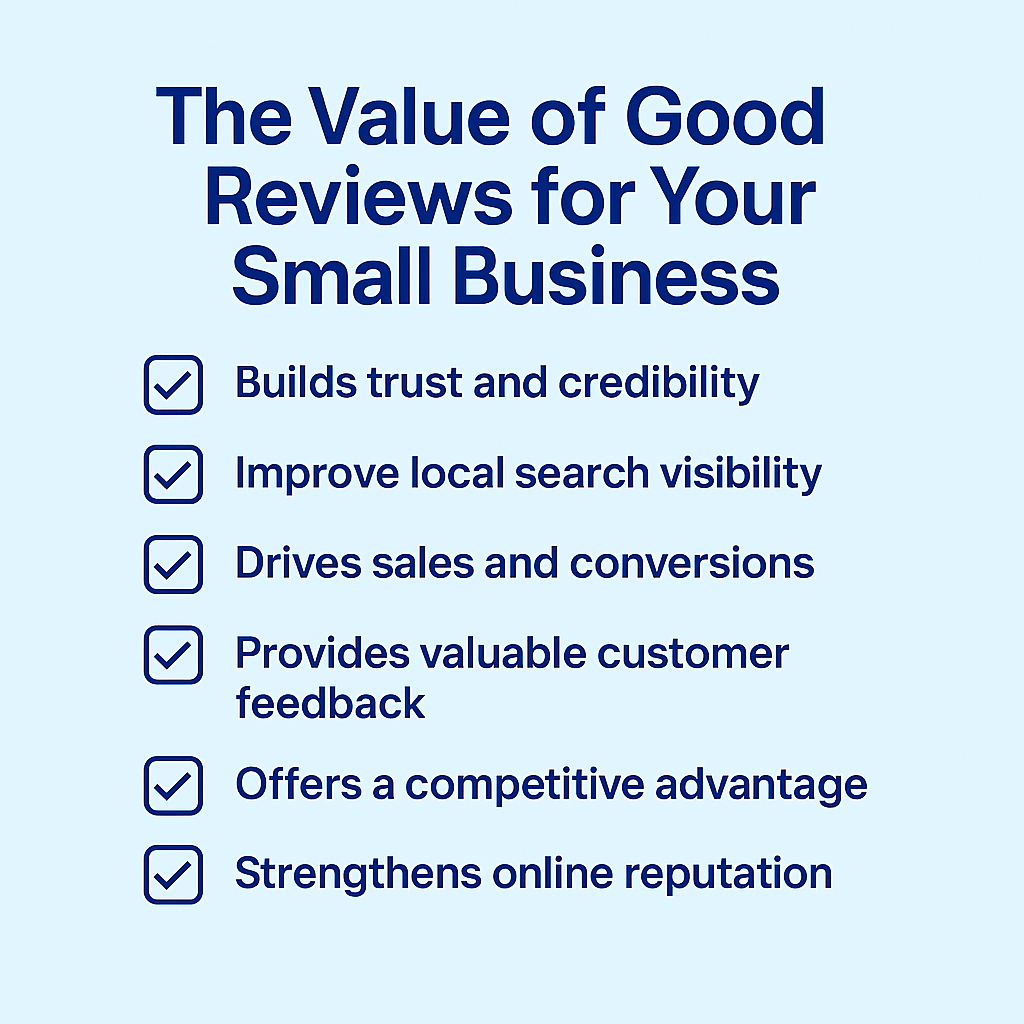
The Value of Good Reviews for Your Small Business

In today’s digital‑first marketplace, customer reviews have become one of the most influential forces shaping how people choose where to shop, who to hire, and what to buy. For small businesses especially, good reviews are no longer optional—they are a core asset that builds trust, drives visibility, and directly impacts revenue.

This article breaks down why reviews matter more than ever in 2026, and how small businesses can leverage them for growth.


1. Reviews Shape First Impressions and Build Trust

Modern consumers rely heavily on reviews to make confident decisions.
Research shows that 97% of consumers lean on reviews to guide their purchase decisions, demonstrating how “cemented” peer recommendations have become in buying behavior.

Similarly, surveys show that 93% of customers read online reviews before making a purchase—meaning your reputation is often judged before someone ever visits your website or storefront.

Star ratings and recency matter, too. The 2026 Local Consumer Review Survey found that customers increasingly expect 4.5‑star ratings or higher, and outdated reviews are losing influence.


2. Reviews Influence Local Search Rankings and Online Visibility

Good reviews don’t just persuade customers—they help your business get found.

Data from the Better Business Bureau highlights that reviews significantly contribute to local SEO, with surveys showing that reviews influence 15% of local search ranking factors.

Platforms like Google prioritize businesses with consistent, recent, and positive reviews, meaning your reputation directly impacts how high you appear in local search or Google Maps results.

Good reviews also appear in search snippets, which makes your business more clickable and appealing before a visitor ever reaches your website.


3. Positive Reviews Drive Sales and Conversions

The connection between reviews and revenue is dramatic and well‑documented:

  • A study shows that products with five reviews are 270% more likely to be purchased than those with zero reviews.
  • A one‑star rating increase can boost business revenue by 5–9%.
  • Reviews influence 32% of purchasing decisions, surpassing even discounts or coupons.

When shoppers see a consistent pattern of positive experiences, it reduces perceived risk and increases their confidence in choosing your business.


4. Good Reviews Provide Valuable Customer Feedback

Beyond marketing benefits, reviews offer genuine insight into what customers love—and what needs improvement.

Reviews reveal trends, highlight weaknesses, and give small businesses actionable data they can use to improve products, services, or customer processes.

Whether customers mention slow service, packaging issues, or exceptional staff, this feedback acts as continuous market research—at no cost.


5. Reviews Offer a Competitive Advantage

Research from the Better Business Bureau notes that 82% of consumers read online reviews for local businesses, and the majority use them for comparison shopping.

When your business has more—and better—reviews than your competitors, you instantly stand out. A competitor with weak or few reviews may be overlooked, regardless of price or convenience.

Positive reviews also help small businesses compete with larger chains by demonstrating personalized service and community trust.


6. Responding to Reviews Builds Credibility and Customer Loyalty

Modern consumers expect businesses to acknowledge feedback.
Data from the 2026 survey shows that slow or generic responses are now viewed as red flags, while quick, personalized replies strengthen trust.

Other research shows:

  • 56% of consumers prefer businesses that respond to reviews.
  • Reviews that get a response can generate 12% more revenue.

Engaging with reviews—positive or negative—signals professionalism, transparency, and customer care.


7. Good Reviews Strengthen Your Overall Online Reputation

Online reputation is one of the most important trust signals in the digital age.
According to review statistics, 72% of consumers trust a local business more after reading positive reviews.

Ratings, review volume, and recency all shape how credible your business appears across platforms like Google, Yelp, Facebook, and industry‑specific review sites.

Reputation is especially important in competitive sectors like home services, healthcare, retail, and hospitality, where customers do extensive online comparison before deciding.


8. Reviews Help Combat the Growing Challenge of Misinformation

Consumers today are more aware of fake or AI‑generated reviews.
A 2026 report shows that 62% of shoppers are concerned about review censorship or manipulation, and many use multiple platforms to verify authenticity.

For small businesses, maintaining a steady flow of real, positive reviews signals transparency and reliability, helping build trust in a skeptical marketplace.


Conclusion: Good Reviews Are One of Your Most Valuable Business Assets

In 2026, good reviews do much more than improve reputation—they:

  • Increase your visibility in search results
  • Build trust and credibility
  • Boost conversions and revenue
  • Offer valuable business insights
  • Give you an edge over competitors
  • Strengthen long‑term customer loyalty

With 97% of consumers relying on reviews and 93% checking them before buying, the power of good reviews for small businesses has never been greater.

Why Proper Signage Is Essential for Your Small Business

In a world where customers are constantly bombarded with digital ads, social posts, and online promotions, one of the most powerful—and often overlooked—marketing tools is right outside your front door: your signage.

For small businesses, proper signage does far more than display your name. It builds recognition, attracts customers, communicates your brand, and increases foot traffic. Whether you’re a retailer, restaurant, service provider, contractor, or local professional, the right signage can have a direct impact on your visibility and revenue.

Here’s why signage matters—and how your business can use it effectively.


1. Signage Is Your First Impression

Before a potential customer ever speaks to you or steps inside, your sign tells them who you are. A clean, professional, eye‑catching sign signals:

  • Trustworthiness
  • Stability and professionalism
  • Brand quality
  • What type of business you are

A poor or outdated sign can have the opposite effect—driving people away before you ever get the chance to earn their business.


2. It Works 24/7—Even When You’re Closed

Signage is always “on.” Unlike digital ads or temporary marketing campaigns, your exterior sign promotes your business around the clock.

People driving or walking by your location multiple times per day begin to recognize your brand. This repetition builds familiarity, which increases the likelihood they’ll choose you when they need your product or service.


3. It Increases Foot Traffic and Local Visibility

Especially for small, local businesses, visibility = opportunity.

Great signage:

  • Captures attention
  • Brings in curious walk‑ins
  • Increases impulse visits
  • Helps customers find you
  • Sets you apart from neighboring businesses

For brick‑and‑mortar locations, signage can be one of the biggest contributors to new customer acquisition.


4. It Reinforces Your Brand Identity

Your signs—colors, fonts, logos, and messaging—all work together to create a brand experience. Consistent branding helps customers:

  • Remember your business
  • Trust your professionalism
  • Associate your business with a specific look or feeling

Strong branding increases sales, loyalty, and word‑of‑mouth referrals.


5. It Can Promote Your Products, Services, or Specials

Signage isn’t just about your business name. It can also:

  • Announce promotions
  • Advertise services
  • Highlight seasonal specials
  • Display new products
  • Share business hours or customer instructions

A simple banner or sidewalk sign can significantly increase conversions—especially for limited‑time offers.


6. It’s One of the Most Cost‑Effective Marketing Tools

Compared to ongoing digital advertising costs, signage is a one‑time investment that delivers continuous results. High‑quality signs can last for years, making them one of the most affordable forms of marketing for small businesses.

For businesses on a budget, signage provides tremendous ROI.


7. It Helps Customers Navigate and Feel Welcome

Interior and exterior signage helps customers know exactly where to go:

  • Entrance signs
  • Directional signs
  • Parking signs
  • Menu boards
  • Service signs

Clear signage reduces frustration, improves customer experience, and increases the chance of a sale.


Final Thoughts

Proper signage is more than decoration—it’s a powerful marketing asset that increases visibility, drives foot traffic, builds brand recognition, and enhances the customer experience.

Whether you need exterior signs, banners, building signage, or promotional materials, investing in professional signage is one of the smartest decisions a small business can make.