Why Local Businesses Struggle With Marketingâand How the Right Support Can Change Everything
Many serviceâarea businesses know they need marketing help but donât know where to start. Learn how the right local support can drive real growth.
Local SEO helps your business get found by customers searching nearby. Learn why local search optimization is essential for visibility, leads, and longâterm growth.
Artificial intelligence has quickly become one of the most talkedâabout tools in digital marketing. From writing blog posts to generating keyword ideas, AI promises faster results, lower costs, and instant execution.
So the question many business owners are now asking is simple:
Should you use AI to rank your website â or hire a marketing agency?
The real answer isnât as black and white as it seems. Letâs break down what AI can do, where it falls short, and why businesses that rely on rankings for revenue still need expert strategy.
What AI Is Actually Good At for SEO
Thereâs no denying it â AI can be a powerful tool when used correctly.
AI excels at:
Generating content drafts quickly
Brainstorming topic ideas
Suggesting keywords and variations
Writing meta titles and descriptions
Analyzing surfaceâlevel competitor content
Speeding up research and execution
For businesses that already understand SEO fundamentals, AI can dramatically increase efficiency. It saves time, reduces manual work, and helps scale content production.
But speed alone does not equal results.
Hereâs where many businesses run into trouble.
AI does not understand context, risk, or longâterm strategy. It produces information based on patterns, not business goals or search engine nuance.
AI cannot:
In fact, many sites using AI alone end up:
AI will happily give you an answer â but it wonât tell you if itâs the right answer.
One of the biggest misconceptions about SEO is that itâs just about content.
In reality, ranking involves:
AI might help write a blog post â but it doesnât build a cohesive system that turns visibility into revenue.
Thatâs where strategy matters.
A professional agency brings experience, accountability, and judgment â the things AI lacks.
A good agency:
At NEADSO, weâve seen firsthand that rankings without conversion are meaningless. Traffic is only valuable if it produces growth.
AI doesnât understand your margins.
AI doesnât know your customers.
AI doesnât care if your phone rings.
An experienced agency does.
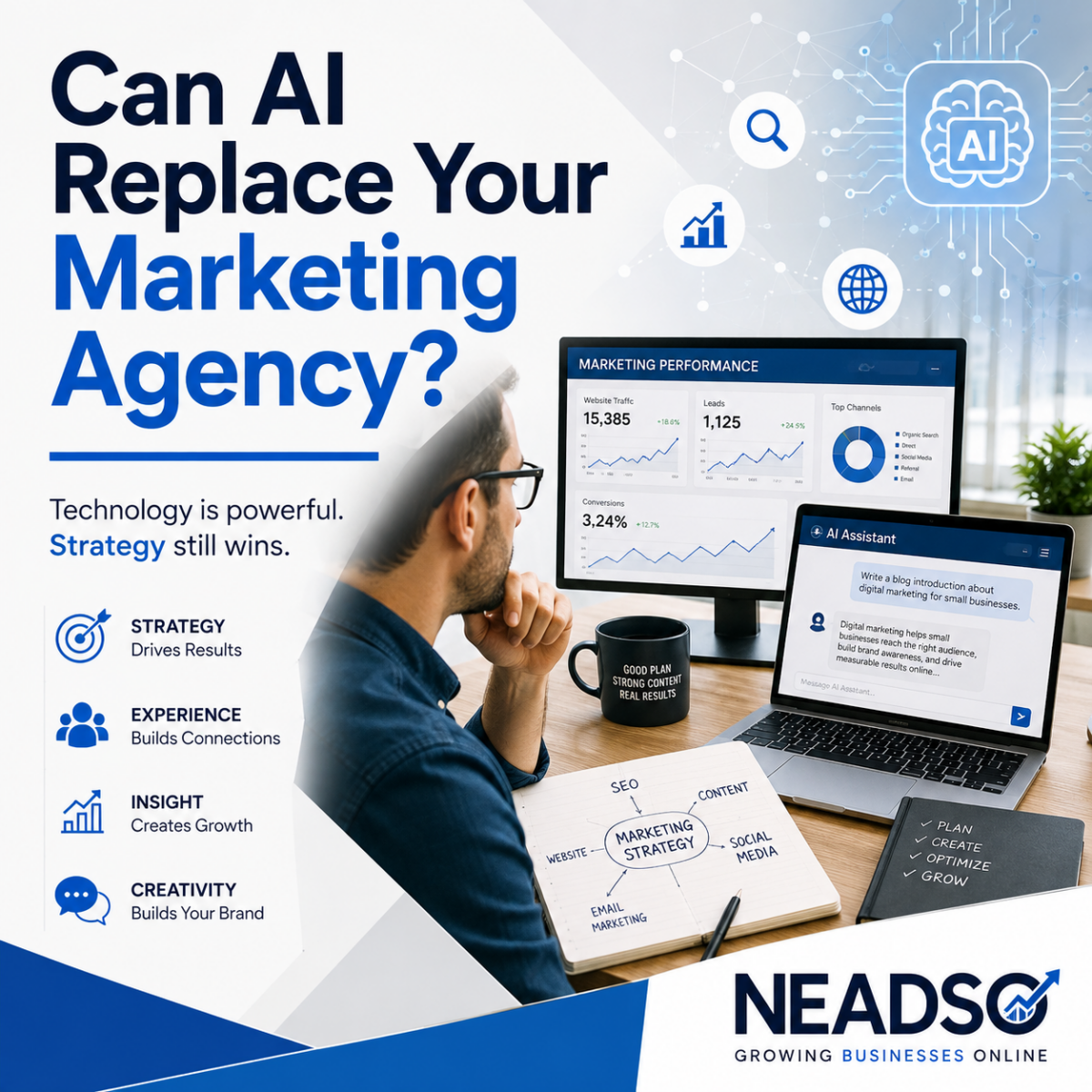
The most successful businesses donât choose AI instead of an agency.
They choose:
Used correctly, AI becomes an accelerator â not a replacement.
Think of AI as the engine.
The agency is the driver, the map, and the mechanic.
Without direction, even the fastest engine goes nowhere.
Using AI without an agency may be acceptable if:
For most businesses, however, SEO mistakes are expensive â not just in rankings, but in lost opportunities.
Hiring an agency is the smarter move when:
SEO isnât about gaming algorithms. Itâs about building visibility that turns into customers.
AI is transforming digital marketing, and itâs here to stay. But tools alone donât create success â strategy does.
AI replaces repetitive tasks. AI speeds up execution. AI improves efficiency.
But AI does not replace experience.
The businesses winning in search are the ones combining:
At NEADSO, we believe AI should support your marketing â not run it.
Want to learn how an expertâled strategy, powered by modern tools, can help your business grow?
đ Learn more at neadso.com
If youâve ever asked yourself, âWhy doesnât my business show up on Google?â â youâre not alone.
Many business owners assume Google magically finds and ranks their website. In reality, Google follows a very specific process to discover, understand, and rank businesses online.
Understanding how this process works is the first step to improving your visibility and attracting more customers.
Before Google can rank your business, it has to know you exist.
Google finds businesses in several key ways:
If your business is missing or inconsistent across these places, Google may struggle to trust or show your information.
Tip: If your website isnât properly built or indexed, Google may never fully âseeâ it.
Google doesnât âseeâ your website the way people do.
Instead, it reads code, words, structure, and signals to understand:
Clear page titles, readable content, and location-specific keywords help Google accurately categorize your business.
For example:
âWindow Installation in Rhode Islandâ is clearer than
âQuality Services You Can Trustâ
The clearer your message, the easier it is for Google to match your business to real searches.
When people search things like:
Google prioritizes businesses that clearly show where they are located.
This comes from:
If your location data is inconsistent across the web, Google may rank a competitor instead.
Googleâs main goal is to show users businesses they can trust.
To decide this, Google looks for signals like:
A neglected or outdated website sends the wrong message â not just to customers, but to Google.
Google favors businesses that educate and provide value.
Helpful content shows Google:
Examples of strong content include:
This is why blogging and regular updates play a big role in long-term SEO success.
One of the biggest mistakes businesses make is being inconsistent online.
Google expects:
Even small variations can hurt your credibility in search results.
Consistency builds confidence â for Google and for customers.
Google doesnât rank businesses overnight.
SEO success comes from:
The businesses that rank well are usually the ones that committed to doing it right â not the ones looking for shortcuts.
If Google isnât sending customers your way, itâs usually not about luck.
Itâs about visibility, clarity, trust, and consistency.
Understanding how Google really finds your business allows you to:
At Northeast Advertising Solutions, we help businesses build websites and digital strategies that Google understands â and customers trust.
If youâre ready to improve how your business shows up online, weâre here to help.
If you’re like most small business owners, youâve tried multiple marketing tactics â boosted posts, Google ads, social media content, email blasts â yet the results just donât match the effort or investment. Youâre not alone. Most businesses arenât struggling because they lack good ideas. Theyâre struggling because their marketing is built on the wrong foundation.
Hereâs the truth:
Marketing doesnât fail because of the ads â it fails because of the system behind the ads.
And the good news? You can fix it.
Below are the five most common breakdowns â and the exact fiveâstep fix that turns everything around.
Boosting a post is not a strategy. Posting on Instagram is not a strategy. Running a few Google ads is not a strategy.
Those are tactics â and tactics without strategy always lose.
The Fix:
Build a simple, clear strategy by answering three questions:
Once you can answer these clearly, your marketing has direction â not guesswork.
Most marketing fails because the message is confusing, too complicated, or too focused on the business instead of the customer.
People buy when they understand how you make their life better, not when they understand your entire business story.
The Fix:
Use this simple messaging formula:
Example:
âParents are overwhelmed. Our daycare gives them peace of mind through safe, structured child care.â
Clear. Direct. Customerâfocused.
Even if your ads are great, most leads die on the website.
Common issues:
A beautiful website is nice â but a converting website is profitable.
The Fix:
Every page needs:
Your website should act like a salesperson â not a brochure.
Most business owners donât have a marketing problem â they have a data problem.
If you canât measure:
âŚyouâre marketing blind.
The Fix:
Set up simple, automatic tracking using:
Small data changes lead to big revenue gains.
Marketing rarely works instantly. Most campaigns need:
Most businesses stop right before their campaigns start to perform.
The Fix:
Commit to a 90âday minimum cycle:
Marketing is a system, not a slot machine.
NEADSO specializes in turning broken marketing systems into profitable, dataâdriven growth engines for small businesses. Instead of cookieâcutter tactics, we build custom strategies that convert visibility into revenue â every time.
đ Schedule a free consultation
đ Letâs build a marketing system that finally works – 401-339-0006
Small businesses often believe that success online comes from one big change â a redesigned website, a new marketing platform, or a major ad campaign. But the real competitive advantage in todayâs digital landscape isnât one massive overhaul. Itâs something far more practical, far more achievable, and far more powerful:
This strategy focuses on small, consistent, highâimpact actions that build longâterm digital strength. For most small business owners, this is the difference between feeling stuck online and finally gaining traction.
And in 2026, this approach matters more than ever.
Itâs the idea that consistent, incremental actions across your SEO, social media, and paid search create exponential results over time.
Instead of chasing trends or trying to âdo everything,â businesses build predictable growth through manageable steps.
This aligns perfectly with how modern digital platforms reward brands:
Small actions â repeated consistently â big results.
Most business owners face two major challenges:
They know they need SEO, social media, ads, content, and reviewsâŚ
But they donât know where to start â or how to keep it going.
MicroâMomentum removes the overwhelm. It turns digital marketing into a daily or weekly routine instead of a onceâaâyear panic.
You don’t need a full site rebuild to improve performance.
Updating one service page, adding an FAQ, or posting a short blog once a week creates a compounding SEO advantage.
Google rewards activity, not perfection.
You don’t need to go viral.
You just need:
This tells platforms you’re active â which increases your organic reach.
Consistency beats creativity.
Instead of âset it and forget it,â small changes can dramatically improve ROI:
PPC improves over time â if you keep touching it.
Because digital platforms (Google, Facebook, Instagram, TikTok) measure:
Big actions create short spikes.
Small actions create long-term growth.
Your competitors may post once a month, update their website once a year, or check their ads once a quarter.
You win by doing 5 minutes more than they do, more often.
Small businesses donât need massive budgets or teams to win online.
They need a plan built around realistic, repeatable habits â the foundation of MicroâMomentum Marketing.
In a digital world where algorithms reward consistency and customers reward trust, the businesses that commit to small daily or weekly actions will rise above those waiting for the âperfect timeâ to act.
The perfect time doesnât exist.
Momentum does.
And once you build it, everything in your marketing becomes easier.
Google Ads remains one of the fastest and most effective ways for small businesses to get new customersâespecially when buyers are actively searching for what you offer.
Below is a simple, evidenceâbased breakdown of how Google Ads works for small businesses, why itâs so powerful, and how to use it effectively.
Google Ads gives businesses instant placement at the top of search results, unlike SEO which takes months. This visibility captures high-intent searchers exactly when theyâre ready to buy. The top three paid ads capture 41% of clicks.
Search ads appear when people are actively searching for your product or serviceâmeaning they are closer to making a purchase. Google Ads lets small businesses reach customers who are literally âraising their hand.â
Small businesses worry they canât compete with larger advertisers, but research shows Google rewards relevance and ad quality over budget size.
Small and medium businesses earn an average of $8 profit for every $1 spent when campaigns are wellârun.
You set your daily or monthly budget and can pause at any time. There are no minimums. Google Ads uses a payâperâclick model, so you only pay when someone actually clicks.
Every click, call, form submission, and purchase can be tracked, making Google Ads one of the most accountable forms of marketing.
Text ads that appear at the top of Google search results.
Best for: Leads, calls, bookings, service businesses.
Pay only for verified leads (calls/messages).
Best for: Plumbers, electricians, HVAC, cleaners, landscapers.
Also appears at the very top above Search ads.
AI-driven campaigns that show ads across Search, YouTube, Maps, Gmail, and Display.
Best for: eCommerce, businesses with strong tracking, or broad targeting.
Note: Not ideal for very small budgets without strong conversion data.
4. Call Campaigns
Designed to generate direct phone calls from mobile searchers.
Best for: Contractors, medical offices, home services.
Google Ads today is highly AI-driven. This affects small businesses in several ways.
Instead of manually picking every audience detail, Google analyzes behavior signals (search history, device, time, intent) to match your ad with likely buyers.
Google is better at interpreting user intent even if search terms vary.
Your job is to start with strong, high-intent keywords and refine using actual search data.
If your conversion data is messy (spam leads, wrong goals, too many conversions tracked), Googleâs automation will optimize incorrectly.
Campaigns fail when they try to drive traffic, leads, and sales all at once.
Google learns faster when the goal is crystal-clear.
Show ads only in areas where your customers live.
âNear meâ searches have increased by 200%, making local targeting extremely powerful.
Your ad is only half the equation.
A high-converting landing page needs:
This prevents wasted ad spend on irrelevant searches.
Example: A dog groomer could block searches like âDIY grooming tools.â
Negative keywords can reduce wasted spend by 30â50%.
PMax works only when Google has strong conversion data.
Small budgets should usually begin with Search campaigns first.
A local HVAC company launches Google Ads on Tuesday.
By midday, they appear at the top of Search and Maps for âAC repair near me.â
Customers immediately start calling and booking appointments, and the campaign pays for itself within days.
Absolutelyâif set up correctly.
Google Ads can transform a small business when campaigns are focused on:
A well-managed campaign can yield up to 8Ă return on ad spend.
Research, Branding, Packaging, Ad Design, PPC Management
Digital Audit, Market Research, User Experience
For years, creators and small businesses have debated where to put links: in the caption, in the first comment, or simply in the bio. In 2025â2026, Meta has now made the answer clearer than everâand the truth is this:
Meta deprioritizes posts with outbound links in the caption.
And yesâMeta itself has officially recommended using other link placements instead.
Letâs break down whatâs actually happening.
In midâ2025, Meta began showing official recommendations in Page dashboards warning users that including a link in the caption can harm distribution. According to Metaâs own Widely Viewed Content Report:
This means link posts naturally get less reach.
Metaâs official advice:
âĄď¸ Put the link in the first comment, not the caption.
This surfaced directly inside Facebookâs Professional Dashboard across many Pages.
In early 2026, Meta began testing strict linkâposting limits for nonâverified professional accounts:
This is a major shift and further proof that Meta wants users to stay on-platform, not click out.
Across multiple analyses, the reasons are consistent:
Metaâs business model depends on engagement and ad viewing. Outbound links take users away.
â Platforms perform better when posts encourage staying, not leaving.
Video content, images, and text posts receive preferential reach.
Outbound links are flagged as lowerâvalue content.
c. Data proves link posts underperform
Only 2â3% of highly viewed posts include links at all.
This isnât a myth anymoreâitâs documented.
Putting links in comments isnât a hackâitâs Metaâs recommended best practice.
Instagram still does not allow clickable links in captions or comments.
So Meta recommends sticking with:
Instagram is not part of the âput links in commentsâ strategyâthat applies to Facebook only.
This was emphasized in 2025 when Meta formally clarified platformâspecific rules.
â Put links in the first comment
â Use compelling text + visuals in the caption
â Pin the comment with the link
â Test performance differences
â Consider Meta Verified if you rely heavily on link posts (Meta is increasingly payâtoâplay)
â Use âlink in bioâ
â Use Story link stickers
â Use Reel links if verified
â Donât waste time placing links in commentsâtheyâre not clickable
â Threads is starting to show link insights and is becoming linkâfriendly
â LinkedIn still rewards posts with caption links
Meta is actively suppressing link posts in Facebook captionsâand has explicitly said so.
If your goal is reach, keep your captions linkâfree.
Facebook = âlinks in commentsâ
Instagram = âlink in bioâ
Threads = becoming linkâfriendly
LinkedIn = keep links in captions
The myth is no longer a mythâMeta confirmed it.