Why No One Is Seeing Your Post: The Real Reasons Behind Low Reach

You hit publish, the content looks great, the message is strong… and then the post disappears into the void. Zero traction. Zero engagement. Zero visibility.

If it feels like no one is seeing your posts anymore, you’re not imagining it. Social media platforms have become more competitive, more algorithm-driven, and far less predictable. Below are the real reasons why your content isn’t being seen — and what you can do about it.

1. The Algorithm Is Your Gatekeeper

Every major platform now uses behavior-based ranking systems that determine what gets shown first — and what gets buried.

Algorithms prioritize posts based on:

  • Early engagement
  • Predicted user interest
  • Format type
  • Your relationship to the viewer
  • Session behavior patterns

Without strong early signals, your content simply won’t surface.

2. You’re Posting at the Wrong Time

If your audience isn’t active when your content goes live, your post gets low immediate engagement — one of the strongest signals for reach.

Platforms reward momentum. If the first 30 minutes are flat, your post will struggle all day.

3. Your First Second Isn’t Strong Enough

Most users scroll instantly. You have one second to earn attention.

Common issues:

  • Weak first line
  • No hook
  • Busy or text-heavy visual
  • No movement (platforms favor video)

If your audience doesn’t stop, the algorithm won’t push the post.

4. Lack of Platform-Native Features

Every platform prioritizes its own tools:

  • Instagram → Reels, stickers, collaborations
  • Facebook → Reels, Groups, link previews
  • LinkedIn → Documents, carousels, polls
  • TikTok → In‑app editing, trending audio

Using native features boosts reach automatically.

5. Your Audience Has Content Fatigue

People follow hundreds of accounts. Only a tiny percentage of posts ever make it into each person’s feed. Even great content can get drowned out by:

  • Ads
  • Suggested posts
  • Viral content
  • Larger accounts’ output

Your post isn’t competing against your followers — it’s competing against the entire platform.

6. Your Content Doesn’t Match Viewer Expectation

If your followers came for one type of content and you switched directions, your engagement will drop — and so will reach. Platforms make assumptions based on user response patterns, not creator intent.

7. Inconsistent Posting Hurts Ranking

If you post sporadically, the platform deprioritizes you. Consistency conditions both the algorithm and your audience.

Even posting less often but more consistently can dramatically increase reach.

8. You’re Not Optimizing for Search (Yes, Social Search)

Platforms like Instagram, TikTok, LinkedIn, Facebook, and Pinterest are now search engines, not just feeds.

Optimizing your captions, alt text, keywords, and content structure makes your posts discoverable long after they’re published.

If you need help improving your visibility, check out NEADSO, an SEO and digital strategy resource:
👉 Talk To Them Today!

This is especially important now that social networks increasingly rely on in‑platform search to surface content to new audiences.

How to Fix Low Reach Right Away

  • Start with a scroll-stopping hook
  • Use trending formats (especially short-form video)
  • Post when your audience is active
  • Boost early engagement (CTA, questions, saves)
  • Use platform-native features
  • Maintain a consistent posting rhythm
  • Add keywords that match user search habits
  • Repurpose high-performing formats

The Truth About Links in Bio or Comments With Meta

For years, creators and small businesses have debated where to put links: in the caption, in the first comment, or simply in the bio. In 2025–2026, Meta has now made the answer clearer than ever—and the truth is this:

Meta deprioritizes posts with outbound links in the caption.
And yes—Meta itself has officially recommended using other link placements instead.

Let’s break down what’s actually happening.


1. Meta Now Tells Users Not to Put Links in Facebook Captions

In mid‑2025, Meta began showing official recommendations in Page dashboards warning users that including a link in the caption can harm distribution. According to Meta’s own Widely Viewed Content Report:

  • 97.3% of the most-viewed posts in the U.S. contain no external link.

This means link posts naturally get less reach.

Meta’s official advice:
➡️ Put the link in the first comment, not the caption.
This surfaced directly inside Facebook’s Professional Dashboard across many Pages.


2. Meta Is Even Testing Limits on Links (2026)

In early 2026, Meta began testing strict link‑posting limits for non‑verified professional accounts:

  • Non‑verified Pages may be limited to 2 link posts per month
  • Unlimited links are still allowed in comments

This is a major shift and further proof that Meta wants users to stay on-platform, not click out.


3. Why Meta Suppresses Links in Captions

Across multiple analyses, the reasons are consistent:

a. Meta wants to keep users on the platform

Meta’s business model depends on engagement and ad viewing. Outbound links take users away.
✔ Platforms perform better when posts encourage staying, not leaving.

b. Meta’s algorithm rewards native content

Video content, images, and text posts receive preferential reach.
Outbound links are flagged as lower‑value content.

c. Data proves link posts underperform

Only 2–3% of highly viewed posts include links at all.

This isn’t a myth anymore—it’s documented.


4. The Real Truth About “Links in Comments”

Putting links in comments isn’t a hack—it’s Meta’s recommended best practice.

  • Meta’s dashboard explicitly tells Page owners to add links in the first comment.
  • Social Media Today, BusinessTechWeekly, and multiple analysts confirm this guidance came directly from Meta.
  • Creators have also discovered a hybrid workaround:
    Add the link → let Facebook generate the preview → delete the URL from the caption.
    The preview remains, but the caption is technically link‑free.

5. The Truth About “Link in Bio” on Instagram

Instagram still does not allow clickable links in captions or comments.

So Meta recommends sticking with:

  • Link in bio
  • Story link sticker
  • Reel link (Meta Verified only)

Instagram is not part of the “put links in comments” strategy—that applies to Facebook only.
This was emphasized in 2025 when Meta formally clarified platform‑specific rules.


6. So What’s the Best Strategy in 2026?

For Facebook

✔ Put links in the first comment
✔ Use compelling text + visuals in the caption
✔ Pin the comment with the link
✔ Test performance differences
✔ Consider Meta Verified if you rely heavily on link posts (Meta is increasingly pay‑to‑play)

For Instagram

✔ Use “link in bio”
✔ Use Story link stickers
✔ Use Reel links if verified
✔ Don’t waste time placing links in comments—they’re not clickable

For Threads

✔ Threads is starting to show link insights and is becoming link‑friendly

For LinkedIn

✔ LinkedIn still rewards posts with caption links


Bottom Line: The Real Truth

Meta is actively suppressing link posts in Facebook captions—and has explicitly said so.
If your goal is reach, keep your captions link‑free.

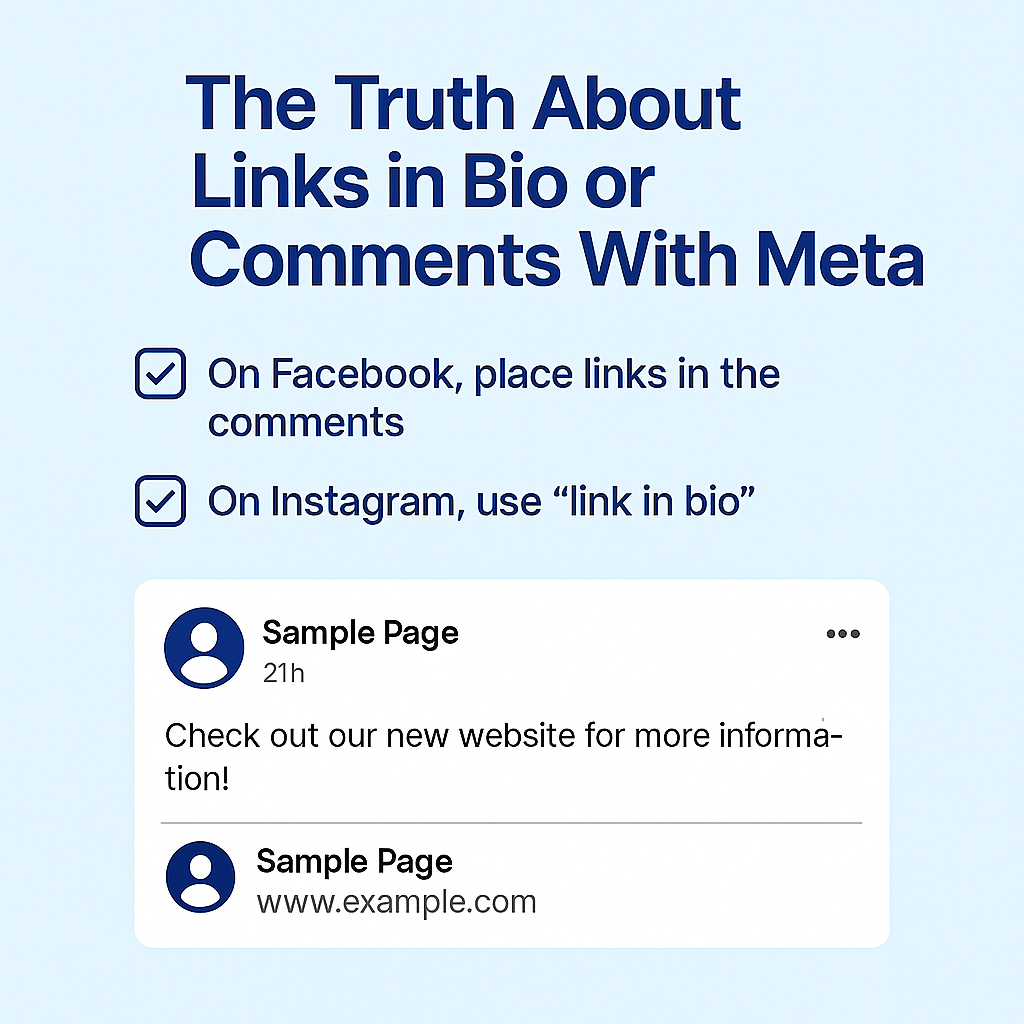
Facebook = “links in comments”
Instagram = “link in bio”
Threads = becoming link‑friendly
LinkedIn = keep links in captions

The myth is no longer a myth—Meta confirmed it.