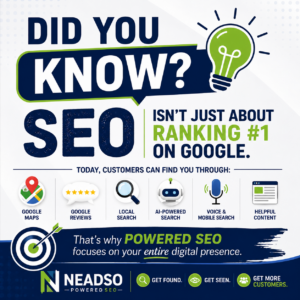
If you’ve ever wondered why one business consistently appears at the top of Google while another seems invisible, you’re not alone.
One of the most common questions we hear at NEADSO is:
“How do I get Google to recommend my website?”
The truth is, Google doesn’t “recommend” websites the way a friend recommends a restaurant. Instead, Google uses incredibly sophisticated algorithms to determine which websites are the best answer for a person’s search.
Every time someone types a question into Google, thousands—even millions—of pages compete for those top positions. Google’s job is to deliver the most helpful, trustworthy, and relevant results in a fraction of a second.
So, what makes Google choose your website over someone else’s?
Let’s break it down.
1. Helpful Content Comes First
Google’s primary goal is to satisfy the searcher’s intent.
If someone searches:
- Best roofing contractor near me
- How much does bathtub reglazing cost?
- Divorce attorney in Rhode Island
Google wants to show pages that completely answer those questions.
The best-performing websites publish content that educates instead of simply selling.
Instead of saying:
“We’re the best contractor in town.”
Show visitors:
- How the process works
- Common questions
- Pricing expectations
- Before-and-after examples
- Helpful guides
The more useful your content is, the more likely Google is to reward it.
2. Your Website Must Demonstrate Expertise
Google wants to know:
Can this business actually be trusted?
This is where Google’s E-E-A-T guidelines come into play:
- Experience
- Expertise
- Authoritativeness
- Trustworthiness
Ways to build trust include:
- Real customer reviews
- Detailed service pages
- Author information
- Professional certifications
- Years in business
- Original photos
- Case studies
Businesses that prove their expertise generally perform better than those making unsupported claims.
3. Fresh Content Signals an Active Business
Google prefers websites that continue to grow.
That doesn’t mean publishing daily.
It means regularly adding:
- Blog articles
- New service pages
- Project galleries
- FAQs
- Customer success stories
Fresh content tells Google:
“This business is active and keeping its information current.”
4. Strong Local SEO Matters
For local businesses, Google looks beyond your website.
It also evaluates your:
- Google Business Profile
- Reviews
- Business citations
- Local backlinks
- Consistent business information
If your business serves a local market, optimizing your Google Business Profile can be just as important as optimizing your website.
5. Your Website Must Load Quickly
Visitors expect websites to load almost instantly.
A slow website increases bounce rates and sends negative signals to Google.
Improve speed by:
- Compressing images
- Using quality hosting
- Removing unnecessary plugins
- Caching pages
- Optimizing code
Speed won’t compensate for poor content—but it can make great content perform even better.
6. Mobile Experience Is Essential
More than half of all Google searches happen on mobile devices.
Google evaluates how your site performs on phones before desktops.
Your website should:
- Resize properly
- Have readable text
- Feature easy-to-tap buttons
- Load quickly
- Offer simple navigation
A poor mobile experience can significantly hurt your rankings.
7. Internal Linking Helps Google Understand Your Website
Think of your website like a roadmap.
Every page should naturally connect to related pages.
For example:
A blog about local SEO should link to:
- SEO services
- Google Business Profile optimization
- Content marketing
- Website design
These internal links help Google understand your site’s structure and keep visitors engaged longer.
8. Quality Backlinks Build Authority
Backlinks are links from other websites pointing to yours.
When reputable websites mention your business, Google views those links as votes of confidence.
Quality matters far more than quantity.
A few links from respected organizations often outweigh hundreds of low-quality directory listings.
9. User Experience Matters
Google measures how users interact with your website.
Positive signals include:
- Visitors spending time reading
- Clicking through multiple pages
- Finding the information they need
- Returning to your website later
If users immediately leave because the page isn’t helpful, Google notices.
The goal is to create content that genuinely answers questions and encourages visitors to explore further.
10. Consistency Wins Over Shortcuts
Many businesses search for a quick SEO trick.
Google doesn’t reward shortcuts.
Instead, successful websites consistently publish:
- Helpful articles
- Updated service pages
- Customer resources
- Educational content
- Original photos
- Genuine expertise
Over time, these efforts build authority, trust, and visibility.
The Bottom Line
Google recommends websites that provide the best experience for users.
That means creating helpful content, demonstrating expertise, maintaining a fast and mobile-friendly website, earning trust, and consistently updating your site with valuable information.
SEO isn’t about gaming the algorithm—it’s about serving your audience better than your competitors do.
At NEADSO, we help small businesses build websites and content strategies that attract more visitors, earn Google’s trust, and convert those visitors into customers.
Ready to make your website one that Google wants to recommend? Contact NEADSO today to learn how strategic SEO and content marketing can help your business grow.